Small Business Startup Cost Spreadsheet (Free Excel)
Download a free Excel startup cost spreadsheet. Estimate setup costs, six months of cash flow, your reserve, and how much funding you need.
Use this free small business startup cost spreadsheet to estimate how much cash you need before opening day. Add the bills you pay before launch, forecast cash receipts and payments for the first six months, and set a minimum reserve. The workbook finds your largest operating cash shortfall and compares the total funding requirement with the cash you already have.
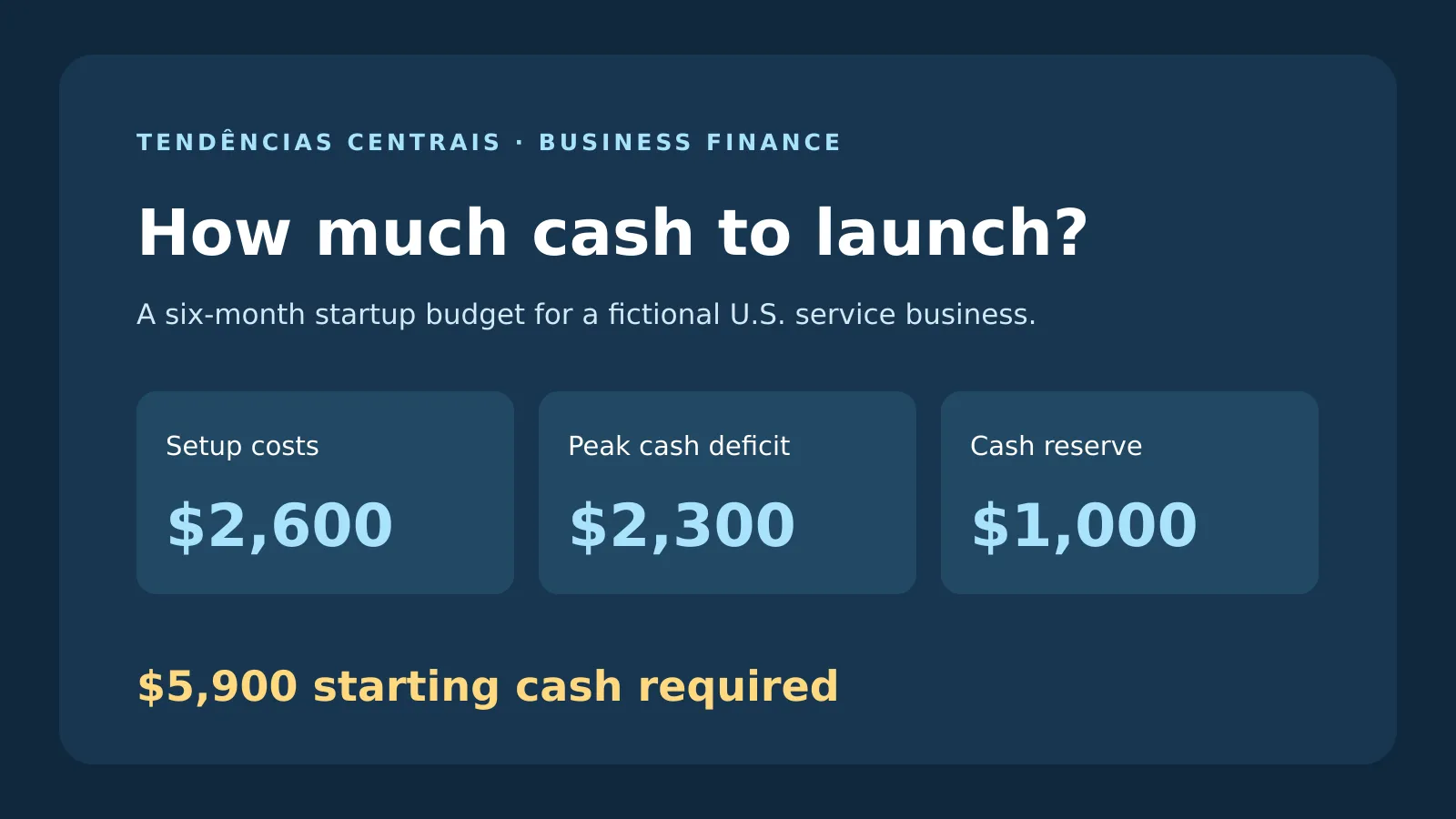
In the fictional U.S. service business below, setup costs total $2,600, the largest operating cash deficit is $2,300, and the owner wants a $1,000 reserve. That puts the starting cash requirement at $5,900. With $4,500 already available, the owner needs another $1,400 or a revised launch plan.
Download the Free Small Business Startup Cost Spreadsheet
Download the startup cost spreadsheet (.xlsx)
The workbook includes a blank Your budget tab and a Worked example tab with the figures from this guide. Enter estimates in the amber cells and read the results in the funding summary. Use zero where a monthly payment or receipt is genuinely zero. The forecast uses six months as a first planning window. Extend the forecast separately if major bills, a seasonal slowdown, or a delayed launch fall beyond month six.
1. List One-Time Startup Costs Before Opening
Start with the payments that must leave your account before you can serve customers. The U.S. Small Business Administration’s business planning guide separates one-time expenses from recurring expenses. The workbook applies that distinction to cash timing, including deposits and prepayments that can use cash before they become accounting expenses.
- Equipment and setup. Include tools, installation, delivery and any testing required before use.
- Opening supplies or inventory. Enter the amount you pay before opening, including freight where it applies.
- Deposits and prepayments. Include cash tied up in a lease deposit, prepaid insurance or another upfront commitment. A refundable deposit still reduces available cash until it is returned.
- Registration and launch costs. Check your business activity and location for permits, fees and professional support. The SBA’s launch guide explains the steps that vary by location and business type.
- Website and launch marketing. Include upfront production, setup or launch advertising that you actually expect to pay.
Record the quote date and what the quote includes. If a vendor asks for 30% upfront and the rest after delivery, put each payment in the period it is due. Keep a written list of uncertain estimates so you can replace them when you receive quotes. Our startup costs by industry guide gives examples of how expense categories change by business model.
2. Forecast Monthly Payments and Cash Receipts
Start with payments you would owe even in a slow month. These might include rent, software, baseline payroll, insurance installments or debt payments. Then add costs that move with sales, such as materials, processing fees, shipping and inventory replenishment. Use the amount you expect to pay that month, even if the expense belongs to another period for accounting purposes.
For cash receipts, ask when customers are likely to pay and when that money becomes available. A $2,000 job invoiced in month one and paid in month two belongs in the month-two cash forecast. If you enter card deposits after processor fees, avoid subtracting those fees again. Keep any personal living costs visible in a separate personal budget, and include a planned owner draw in business cash payments if the business will fund it.
Check your first month by week when deposits, payroll or supplier bills are close together. A month can end with positive cash even if the account runs short halfway through it. For that timing check, use our free 13-week cash flow forecast.
3. Calculate Starting Cash and the Funding Gap
Starting cash required = pre-opening cash payments + peak operating cash deficit + minimum cash reserve.
- Subtract monthly cash payments from cash receipts.
- Add each month’s result to the running total, starting at zero for operating cash flow.
- Find the lowest running total. If it is negative, use its absolute value as the operating deficit. Otherwise use zero.
- Add the operating deficit, the pre-opening payments and your chosen reserve. Subtract available starting funds to find how much extra cash you need. If starting funds already cover the requirement, the workbook shows zero extra needed.
Enter starting funds before deducting setup payments. If those payments have already cleared, use the cash you currently have and model only the setup bills still to be paid. A loan or grant belongs in the available-funds figure only if the money will be usable before the bills modeled here. The workbook assumes an up-front funding comparison. Model staged financing on the dates it becomes available in your weekly cash forecast.
Worked Example: A Six-Month Service Business Budget
This example is hypothetical. The business spends $2,600 before opening and forecasts the following operating receipts and payments. The cumulative column starts at zero and shows the operating shortfall separately from setup.
| Month | Cash received | Cash paid | Cumulative operating cash |
|---|---|---|---|
| 1 | $400 | $1,800 | −$1,400 |
| 2 | $1,000 | $1,800 | −$2,200 |
| 3 | $1,800 | $1,900 | −$2,300 |
| 4 | $2,400 | $2,000 | −$1,900 |
| 5 | $2,800 | $2,100 | −$1,200 |
| 6 | $3,000 | $2,100 | −$300 |
The business starts generating positive monthly operating cash in month four, but the deepest gap arrives in month three. Adding $2,600 in setup payments, $2,300 for that gap and a $1,000 reserve gives $5,900 required at the start. Subtract the $4,500 on hand to get $1,400 in extra funding needed.
Test a slower start. If $700 of expected month-two receipts arrives in month four instead, the cumulative operating deficit reaches $3,000 in month three. Starting cash required rises to $6,600 and the funding gap to $2,100. Duplicating the budget and changing the receipt dates gives the owner a concrete number to use when negotiating a payment schedule or deciding whether to delay a purchase.
Common Startup Budget Mistakes
- Counting the same payment twice. If you prepaid the first month of insurance before launch, begin the recurring payment forecast when the next installment is due.
- Using invoices as cash receipts. Put the money where it is expected to reach the account. Use actual settlement or payment dates as evidence becomes available.
- Using only the end-of-period balance. The biggest cash need can occur months before the end of your plan.
- Leaving the reserve at an arbitrary percentage. Use a separate reserve based on your exposure to delayed payments or surprise bills. If a bill is already included in the forecast, account for it once.
- Assuming cash break-even means profitability. Cash timing and profitability answer different questions. Use our small business break-even calculator to estimate the sales volume needed to cover costs.
Frequently Asked Questions
What should a small business startup cost spreadsheet include?
Include setup payments, monthly cash receipts, operating payments, the largest cumulative cash shortfall, a reserve and available starting funds.
Should opening inventory go under startup costs or monthly expenses?
Record the initial inventory payment in the period you pay it. If you pay before opening, enter it under setup. Put replenishment payments in the months they are due.
How much cash reserve should I plan for?
Set a reserve based on the cash disruptions your business could face, such as a late customer payment or an urgent equipment repair. Test a slower-sales scenario to see whether the reserve you chose still makes sense.
Can I use this spreadsheet for an online or home-based business?
Yes. Use your own categories and include costs that apply to your model, such as marketplace fees, packaging, software and paid marketing. Leave unused setup rows blank.
Does the spreadsheet calculate tax deductions?
It records cash payments for planning. Tax treatment can differ by item and business. Use your records and applicable guidance when determining deductions.
What should I do if my available cash is below the target?
Identify the week or month when the gap occurs. Test a smaller launch, different payment dates or additional funding that would arrive in time. Recheck the forecast after each change.
Build Your First Startup Budget
Download the free Excel workbook, enter your three largest setup quotes, then fill in the first six months of receipts and payments. Duplicate the budget and test one slower-payment scenario before committing to the launch.