Retail Working Capital: How Much Cash Do You Need?
Estimate how much cash your retail store needs. Compare normal and seasonal weeks, find the cash gap, and use a free 13-week Excel forecast.
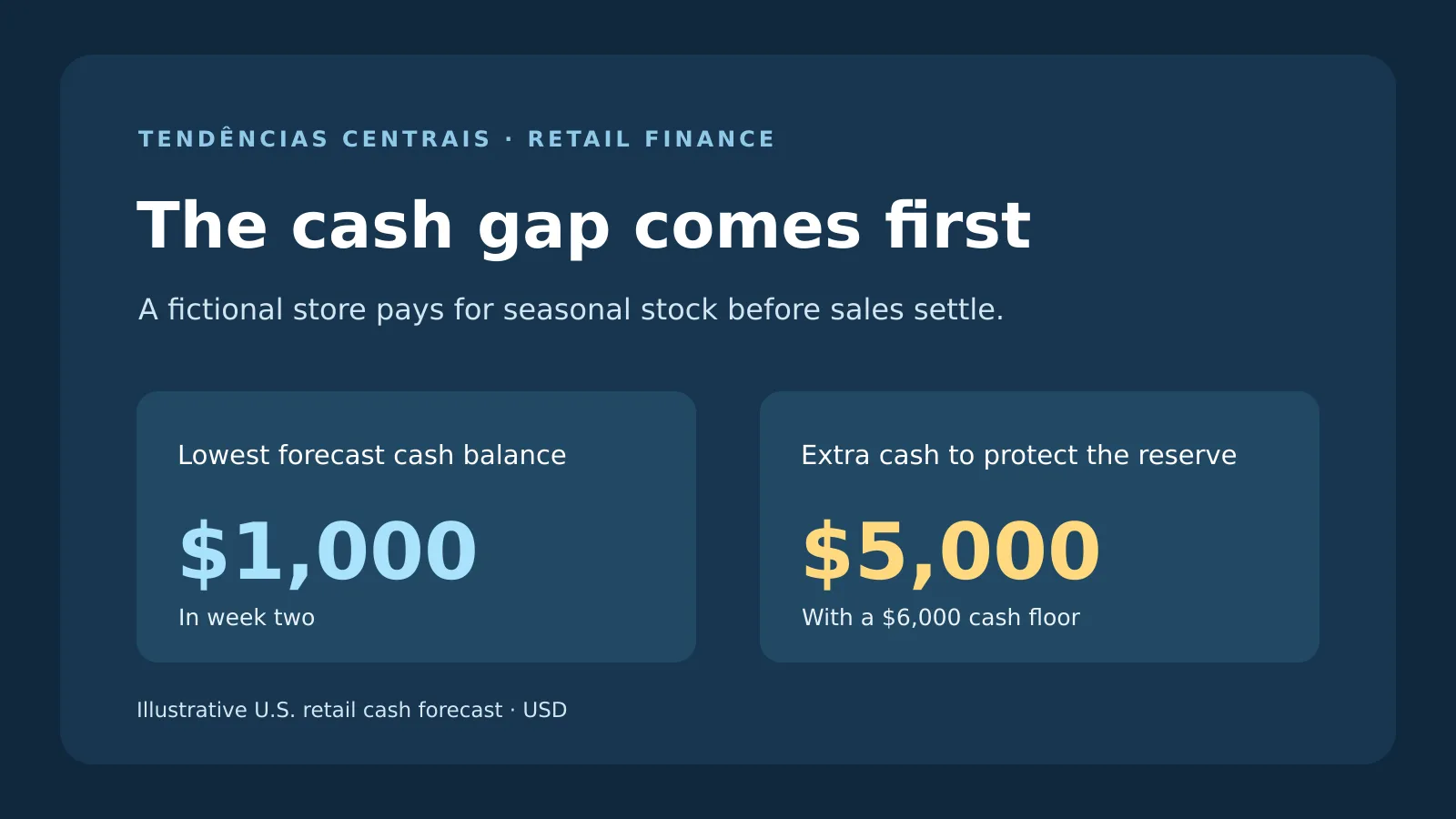
Retail working capital keeps a store operating while cash is tied up in inventory or waiting to settle from card sales. To estimate how much cash you need, forecast what will reach your bank account each week, subtract bills on their actual due dates, and find the lowest projected balance. Compare that balance with the minimum cash you want to keep available for operations.
For example, if a store’s cash forecast bottoms out at $1,000 and it wants to keep a $6,000 reserve, the plan needs $5,000 of additional cash or equivalent changes to payment and receipt timing before the gap occurs. The example below compares an ordinary month with a seasonal buying period using the same opening cash.
What Is Retail Working Capital?
Net working capital = current assets − current liabilities. For a retailer, current assets can include cash, inventory and short-term receivables. Current liabilities can include supplier invoices, taxes payable and short-term debt obligations. A hypothetical store with $12,000 in cash, $24,000 in inventory, $4,000 in short-term receivables and $21,000 in current liabilities has $19,000 in net working capital.
That balance-sheet figure helps describe short-term financial position. To decide whether you can place an order this Friday, look at available cash and payment timing. The $24,000 of inventory may take weeks to sell, and the $4,000 in receivables may arrive after payroll. See our guide to working capital for small businesses for the broader concept.
How to Calculate Retail Working Capital Needs in Cash
Start with a 13-week view so you can see the next purchase cycle and the weeks immediately after it. Use daily dates within any week when payroll, taxes, rent, or a large supplier payment could leave you short before deposits arrive. The FDIC’s Money Smart for Small Business program, developed with the U.S. Small Business Administration, includes training on managing cash flow.
1. Enter cash you can use today
Start with reconciled, available business cash. Account for outstanding payments once, either in your opening balance or on the dates you expect them to clear. Keep restricted cash outside the available balance. A credit line belongs in a separate financing scenario until you know you can draw it and when funds would arrive.
2. Put receipts and bills on the dates cash actually moves
Use expected bank deposit dates for card and marketplace payouts, including weekend delays and any known holds. Put supplier deposits, balances, freight, rent, payroll, taxes and debt payments in the periods they come due. If payouts are already net of processor fees or refunds, avoid deducting those amounts a second time. Sales tax remittances should appear in the forecast when due if the collected cash is included in the forecast balance.
3. Set a cash floor and measure the gap
A cash floor is the minimum balance you want to preserve after the payments already modeled. Set it using your exposure to delays, refunds, emergency expenses and slow sales. In the example, $6,000 is a fictional store policy, not an industry benchmark. Scheduled bills still belong on their due dates. An additional reserve for a bill already forecast would count that same risk twice unless you have a separate reason to hold the buffer.
- Ending cash = opening cash + cash received − cash paid.
- Lowest projected cash = the smallest balance across the opening position and all forecast checkpoints.
- Extra cash needed = the larger of zero and cash floor minus lowest projected cash.
These formulas assume one cash floor and a starting-cash scenario. If your reserve target changes by week, compare each week with its own target and use the largest shortfall. If you plan to add money later, put it into the forecast on its actual available date. An inflow in week four cannot close a week-two gap.
Worked Example: A Normal Month vs. a Seasonal Buying Month
Consider a fictional U.S. gift shop with $12,000 available at the start of week one and a $6,000 cash floor. The store models four weeks inside its 13-week forecast. The seasonal scenario pays for extra merchandise before the busier weeks bring in larger deposits. Amounts below are in U.S. dollars and illustrate timing, rather than typical retail performance.
| Week | Normal receipts | Normal payments | Normal cash | Seasonal receipts | Seasonal payments | Seasonal cash |
|---|---|---|---|---|---|---|
| 1 | $7,000 | $10,000 | $9,000 | $7,000 | $16,000 | $3,000 |
| 2 | $8,000 | $7,000 | $10,000 | $8,000 | $10,000 | $1,000 |
| 3 | $8,000 | $8,000 | $10,000 | $12,000 | $11,000 | $2,000 |
| 4 | $9,000 | $8,000 | $11,000 | $16,000 | $12,000 | $6,000 |
The seasonal plan receives $43,000 over the month, compared with $32,000 in the normal plan. It still falls below the cash floor in weeks one through three. Week two is the lowest point, with $1,000 in cash. If the store changes none of the dates or amounts, it needs $17,000 of opening cash to preserve the $6,000 floor, or $5,000 more than it currently has. The seasonal month ends at $6,000, so a month-end-only check would miss the earlier gap.
How to Close a Retail Cash Gap Before You Order
Test a split shipment or a later supplier payment
Suppose the supplier agrees to move $4,000 of the week-one payment to week four, and delivery timing and sales receipts stay as modeled. The seasonal ending balances become $7,000, $5,000, $6,000 and $6,000. The largest gap falls from $5,000 to $1,000. If the new terms also delay part of the shipment, lower or move the associated sales receipts before relying on that result. Our seasonal inventory guide explains how to stage purchases around demand and supplier lead times.
Forecast a slower-selling case
If $3,000 in week-three seasonal receipts moves to week five under the original payment schedule, week-three ending cash drops from $2,000 to negative $1,000. The gap to the $6,000 reserve becomes $7,000 at that checkpoint. Test slow collections and weak sell-through separately. When a sale is merely delayed, move the receipt forward. When the sale is unlikely to happen, remove it from the forecast.
Check the products tying up cash
Review older inventory at cost and list open purchase orders by next payment date. Look for stock you can sell through, return, or postpone without putting dependable sellers at risk. Pair this review with our retail inventory management guide to compare stockout risk, slow-moving items and buying commitments.
Common Retail Working Capital Forecasting Mistakes
- Using the sale date for every receipt. Use the day the payout reaches your bank and check how holidays affect the schedule.
- Skipping purchase-order deposits and freight. An order can require cash in several stages. Put each amount on its own expected payment date.
- Looking only at Friday balances. If payroll runs Wednesday and a deposit settles Thursday, check the Wednesday low point separately.
- Leaving the model unchanged after the buying decision. Replace estimates with actual cash movements and update future dates as suppliers, sales and settlements change.
Frequently Asked Questions
How much working capital should a small retail store have?
Estimate it from your own inventory cycle and payment calendar. Forecast the lowest cash balance, compare it with your operating reserve, and test at least one slower-sales scenario.
Is retail working capital the same as cash in the bank?
Cash is one current asset. Net working capital also includes other current assets and subtracts current liabilities. Use a cash forecast to see what is available on each payment date.
Does buying inventory always lower net working capital?
Paying cash for inventory can simply move value from one current asset to another at the time of purchase. Cash available for payroll and rent still falls. The forecast captures that drop in spendable cash.
Should I forecast gross or net card receipts?
Use the net deposits you expect from the processor, or model gross receipts and fees separately. Either approach works if it reconciles to the amount reaching the bank and counts fees once.
Can I use a 13-week forecast for a one-off holiday order?
Yes. Include the deposit, balance due, freight, expected settlement dates and a slower sell-through case. Extend the forecast if the order creates commitments beyond week 13.
When should I switch from weekly to daily tracking?
Use daily checkpoints when the week includes a major payment, slow settlement, or a forecast balance close to your cash floor. Return to weekly tracking when the timing risk eases.
Build Your 13-Week Retail Cash Forecast
Get the free cash flow forecast template and enter your available cash, the next three supplier payments and the dates your card or marketplace payouts settle. Duplicate the scenario before adding a seasonal purchase. Compare the lowest balance in each version before committing to the order.